Smart Contract Platforms Explained Through One $5 Transfer
Why can a $5 transfer cost $1 on one network and a fraction of a cent on another? In Part 2 of our Crypto Sectors series, we break down smart contract platforms, Layer 1s, Layer 2s, and what low-fee blockchains mean for everyday payments in emerging markets.

Editor’s Note: Most people treat crypto as one giant, speculative asset class. In reality, it is divided into distinct market sectors—from digital currencies and smart contracts to DeFi and Real-World Assets. This is Part 2 of our 7-part series deconstructing crypto sector by sector through the lens of real-world emerging market utility.
 Steve Jegede
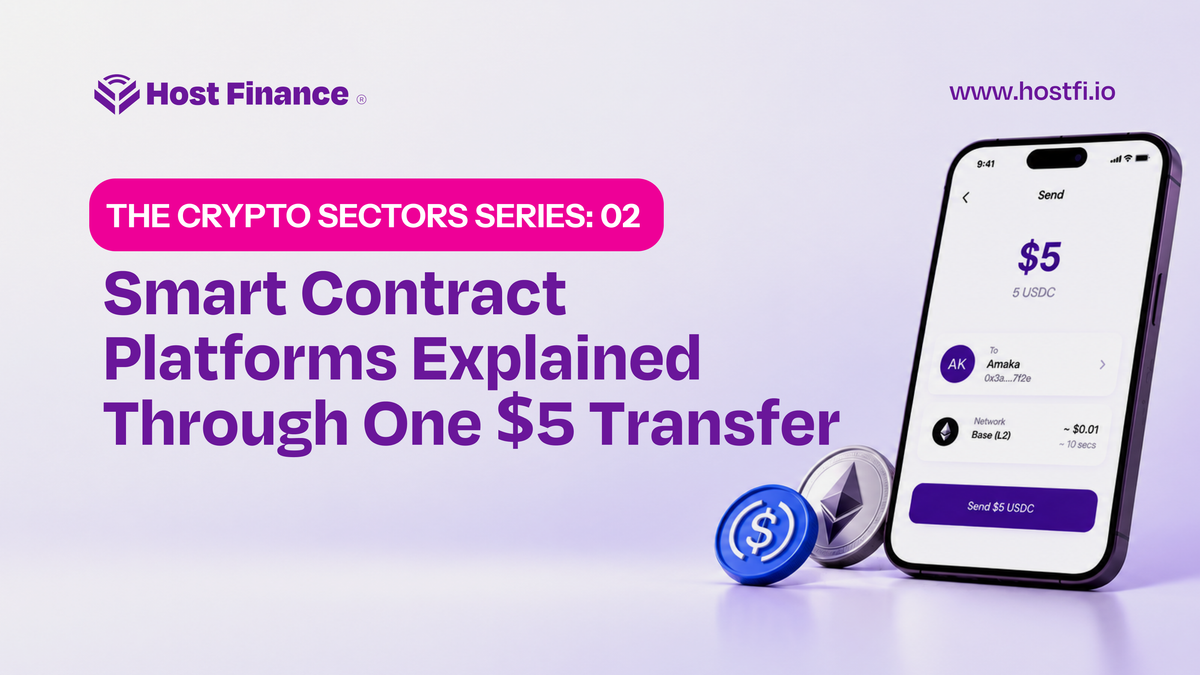
Imagine you want to send $5 USD in digital dollars to a friend across town. The fee you pay for that transfer depends entirely on the smart contract platform you choose. On the Ethereum main network in 2025, the average transaction fee sat near $1 USD. A fee of that size eats 20% of your $5 USD transfer before the money even arrives.
If you send that same $5 USD on a low-fee network like Solana, the 2025 average fee drops to about $0.02 USD, and a snapshot on October 19, 2026, put a transfer near $0.0005 USD. If you route it through a newer network like Base, a USDC token transfer cost about $0.0007 USD on that same October day.
For anyone in emerging markets, the difference between a $1 USD charge and a fraction of a cent decides whether crypto is useful for daily life. In Part 1 of our series, we looked at why people use Bitcoin to protect long-term savings and digital dollars like USDT and USDC for daily spending. Yet stablecoins do not move on their own. They travel on smart contract platforms, and a low-fee blockchain is the main way small on-chain transfers make financial sense.
What Smart Contract Platforms Actually Do
Bitcoin was built first as a digital record book to track who owns which coin. When you send Bitcoin to a shopkeeper, the network records the payment and updates your balance. That is where its main job ends.
Smart contract platforms take that record book and add a computer to it. This started when Ethereum launched on July 30, 2015. Instead of just tracking balances, these networks run small, automatic computer programmes called smart contracts.
In the mid-1990s, computer scientist Nick Szabo compared a smart contract to a vending machine. When you put the right amount of money into a vending machine and press a button, the machine checks the payment and drops your snack into the tray. You do not need a cashier in the middle.
A smart contract works the same way on a blockchain. It follows simple "if-then" rules. When you meet the right conditions, the code runs by itself and moves the money. Every time you send USDT or USDC, use a crypto app, or swap one coin for another, you use a smart contract.
According to a January 2026 report by Grayscale Research, Ether and Solana tokens alone make up about 70% of the investable crypto market outside of Bitcoin. Together, more than 40 smart contract networks held a combined value of about $650 billion USD in January 2026 and handled over 50 billion transactions in 2025.
Why Sending $5 USD Can Cost $1 USD or Less Than a Cent
Running computer code across thousands of machines around the world takes electricity and equipment. To pay the computer operators (called validators) who keep the system safe and honest, networks charge transaction fees. On Ethereum and similar networks, these charges are called gas fees.
Think of gas fees like a ride-share app or a taxi fare. The distance of your trip never changes, but the price goes up when thousands of people try to book a ride at the exact same time. Also, a stablecoin transfer like USDT or USDC requires the network to run a smart contract. That extra computer work uses roughly two to three times more gas than a simple transfer of the network's main coin.
On a base blockchain, every computer on the network has to check and record every single payment. This setup makes the network very safe. For example, Ethereum had around 863,000 active validators on its record book in October 2026, according to Crypto Briefing. However, when hundreds of thousands of computers check every payment, it slows things down. The main Ethereum network can only handle about 15 to 20 transactions per second.
When thousands of people try to send money at the same time, a digital traffic jam happens. Transfers wait in a queue. To jump the line, users offer higher gas fees so validators pick their payment first.
During a quiet moment on October 19, 2026, an Ethereum USDT transfer cost near $0.005 USD. However, the crypto tracker Spark estimated that Ethereum fees sat between $1 USD and $5 USD under normal conditions in mid-2026. When fees can swing from half a cent to $5 USD, small payments for groceries or everyday errands become hard to plan around.
Layer 1 vs Layer 2: How Networks Split the Work
Ethereum co-founder Vitalik Buterin called this traffic problem the "blockchain trilemma." The rule says a network can only master two of three things at the same time, which are decentralisation (no single boss), security, and speed. To fix high fees and make transfers cheap, engineers split the work across two types of networks: Layer 1 and Layer 2.
Layer 1: The Main Highways
A Layer 1 (L1) is a main blockchain that checks, approves, and stores every payment on its own record book. Ethereum, Bitcoin, Solana, Tron, and BNB Chain are all Layer 1 networks.
Ethereum chose maximum security and decentralisation. Other Layer 1 networks took a different path to keep fees low. Instead of hundreds of thousands of computers checking every small payment, networks like Solana, Tron, and BNB Chain use faster computers, smaller groups of validators, or both. Their fees are often much lower, though Tron shows that is not always the case.
Layer 2: The Express Lanes Built on Top
Instead of leaving Ethereum behind, developers built Layer 2 (L2) networks directly on top of it. Ethereum is like a central supreme court, and Layer 2 networks like Arbitrum, Optimism, and Base are the local notary offices.
When you send stablecoins on a Layer 2 rollup, the payment happens off the crowded Ethereum main road. Speeds are fast and fees cost fractions of a cent. The Layer 2 network bundles hundreds of these small payments into one neat package and sends a single receipt back to Ethereum for final safekeeping. Because hundreds of users split the cost of one Ethereum fee, the price per person drops sharply.
Alongside them, independent networks called sidechains (like Polygon PoS) run next to Ethereum with their own validators to offer low costs too. Unlike true Layer 2 rollups, sidechains do not rely directly on the main Ethereum network for security.
As of April to May 2026, Coin Bureau and eco.com reported 73 active Layer 2 rollups holding over $48 billion USD in value, led by Arbitrum and Base. Base alone handled 12.89 million daily transactions in February 2026 and reached $10.7 billion to $11.2 billion USD in locked value as of April 2026, according to Coin Bureau and eco.com.
| Network | Network Type | Transfer Fee (Oct 19, 2026 Snapshot) | Confirmation | Final Settlement |
|---|---|---|---|---|
| Ethereum | Layer 1 | About $0.005 USD | About 12 seconds | About 13 to 16 minutes |
| Tron | Layer 1 | About $2.24 USD (without staked Energy) | About 3 seconds | About 57 seconds |
| Solana | Layer 1 | About $0.0005 USD | About 0.4 seconds | About 12.8 seconds |
| Base | Layer 2 Rollup | About $0.0007 USD (USDC) | About 2 seconds | 7-day window to withdraw to Ethereum |
| Polygon PoS | Sidechain | About $0.0006 USD | About 2 seconds | About 4 to 5 seconds |
Note: Confirmation is when your payment first shows up on the network. Final settlement is when a payment becomes permanent and impossible to reverse. On Ethereum, a payment shows up in 12 seconds, but takes 13 to 16 minutes to settle permanently. In mid-2026, Spark estimated normal Ethereum fees at $1 to $5 USD, and Tron fees at $1.44 USD when users rent network Energy.
How These Networks Compete in Emerging Markets
When crypto experts debate Ethereum vs Solana, they usually talk about coin prices. When people in Africa, Latin America, and Asia compare networks, they look at how much it costs to send money home.
According to the World Bank's Remittance Prices Worldwide report, the global average cost to send $200 USD across borders was 6.36% in the third quarter of 2025. Sub-Saharan Africa was the most expensive region to send money to at an average of 8.46%, while traditional banks were the most expensive channel at 14.99%. High cross-border fees, local currency instability, and severe foreign exchange (dollar) shortages are the main reasons workers, freelancers, and businesses use stablecoins.
A report by Artemis, Castle Island Ventures, and Dragonfly looked at 33 payment companies (22 surveyed directly and 11 estimated). They found that real-world stablecoin payments hit a yearly run rate of $122 billion USD in August 2025. By October 19, 2026, the total global supply of stablecoins sat near $300 billion USD, according to data reported by Coin Alert News. Ethereum held about $162.5 billion USD of that supply (54.1%), Tron held about $94.1 billion USD, and Solana held about 4.8%, or roughly $14.4 billion USD.
Here is how people and businesses actually use these networks on the ground:
- Tron for Retail Transfers: USDT on the Tron network (called TRC-20) is a top choice for everyday payments. In the Artemis study, Tron led global payment volume, ranked first in six of the 10 African countries studied (including Ghana, Egypt, and Ethiopia), and was the main settlement network across most of Latin America. However, Tron is not always the cheapest choice. Without staked network "Energy," a standard USDT transfer cost about $1.92 USD to $2.24 USD in 2026, or about $1.44 USD with rented Energy. Energy is Tron's network resource, which users can lock up or rent to lower their fees. At $2 USD, the fee takes 40% of a $5 USD payment.
- Ethereum for Big Business: Ethereum was the most used payment network by total dollar volume in Nigeria, Kenya, South Africa, Uganda, and Argentina. Separately, the report noted that business-to-business transfers averaged more than $219,000 USD per payment on both Ethereum and Tron. When a company moves $200,000 USD across borders, a $2 USD or $5 USD fee does not matter.
- Solana, Polygon, and BSC for Smaller Payments: For smaller transfers, Solana kept its 2025 average fee near $0.02 USD and sat near $0.0005 USD on October 19, 2026. Across all smart contract platforms, Grayscale Research found an average transaction fee of just $0.04 USD in 2025. Average business payment sizes on Polygon and Binance Smart Chain (BSC) were much smaller than on Ethereum and Tron, which points to their use in smaller or more frequent business payments.
How to Move Money Without Gas Fee Headaches
For an everyday user, all these different networks create a headache. To send $5 USD of USDT on Tron, you normally need to hold Tron's own coin (TRX) in your wallet or have Energy to pay the fee. To send USDC on Base or Polygon, you need ETH or POL on that exact network to cover gas. Worse, if you accidentally send coins from a Polygon address straight to a Solana address, your money can be lost forever.
Payment companies work behind the scenes to hide these wires. For example, Circle's Cross-Chain Transfer Protocol (CCTP) burns (destroys) USDC on one blockchain and mints (creates) the same amount on another. This removes the need for risky third-party coin pools when moving money across networks.
Consumer apps go further and remove network management from your screen entirely. HostFi holds local currency alongside major crypto assets like Bitcoin, Ethereum, Solana, BNB, USDT, and USDC in one simple wallet. Inside the app, you can swap between supported coins at no charge, fund a virtual card in minutes to pay for online subscriptions, or send free peer-to-peer transfers to other HostFi users.
Because those moves stay inside the app, there is no gas coin to buy or manage first. Deposits are free, and fees apply only when you withdraw crypto or local currency out of the platform. If you send $5 USD to a friend who also uses HostFi, the full $5 USD arrives instantly.
The Crypto Sectors Series Roadmap
We break down the entire crypto landscape over seven parts. Here is where we are going:
- Part 1: Currencies and Digital Dollars: Store of Value vs Medium of Exchange
- Part 2: Smart Contract Platforms (You are here)
- Part 3: Financials (DeFi)
- Part 4: Real-World Assets (RWA)
- Part 5: Artificial Intelligence (AI)
- Part 6: DePIN
- Part 7: Consumer and Culture
Frequently Asked Questions
What is a smart contract?
A smart contract is an automatic computer programme stored on a blockchain. It follows simple "if-then" rules and moves money or completes a payment once set conditions are met, without a bank, lawyer, or middleman.
What is the difference between Layer 1 and Layer 2?
A Layer 1 is a main blockchain, such as Ethereum, Bitcoin, or Solana, that checks and permanently records payments on its own record book. A Layer 2 is a secondary network built on top of a Layer 1, such as Base, Arbitrum, or Optimism on Ethereum. Layer 2s process payments off the main road in fast, cheap batches and send a final summary back to Layer 1 for security.
Why are Ethereum gas fees high?
Ethereum puts security and decentralisation first, so hundreds of thousands of independent computers check network activity. Because the main network handles only around 15 to 20 transactions per second, heavy demand creates traffic jams and users bid higher fees to go first. Fees fall when network activity is quiet.
Which blockchain has the lowest fees?
On October 19, 2026, a Cryptsy snapshot put a stablecoin transfer under a tenth of a cent on Solana ($0.0005 USD), Polygon ($0.0006 USD), and Base ($0.0007 USD). Ethereum was about half a cent ($0.005 USD) during a quiet period, while Tron was about $2.24 USD without staked Energy. Across all smart contract platforms in 2025, Grayscale Research found an average fee of $0.04 USD, with Solana averaging about $0.02 USD.
What is a gas fee in crypto?
A gas fee is the small fee you pay to blockchain computer operators for the energy and work needed to check and record your payment. On most networks, you must pay gas in that network's main coin, such as ETH on Ethereum.
Which network is best for USDT transfers?
Tron holds about $94.1 billion USD in stablecoins as of October 2026, almost all of it USDT, and confirms payments in about three seconds. However, it cost about $2 USD to $2.24 USD without staked Energy in 2026. For small USDT transfers, networks like Solana and Polygon were far cheaper in the October 19, 2026 snapshot, costing under a tenth of a cent.