Crypto Subaddress: Track Who Paid You Without Guesswork
A crypto subaddress is an extra deposit address linked to your main wallet. You can give a different one to each person paying you, or use one for each purpose. Every payment shows which address received it, and all the funds stay in the same wallet.

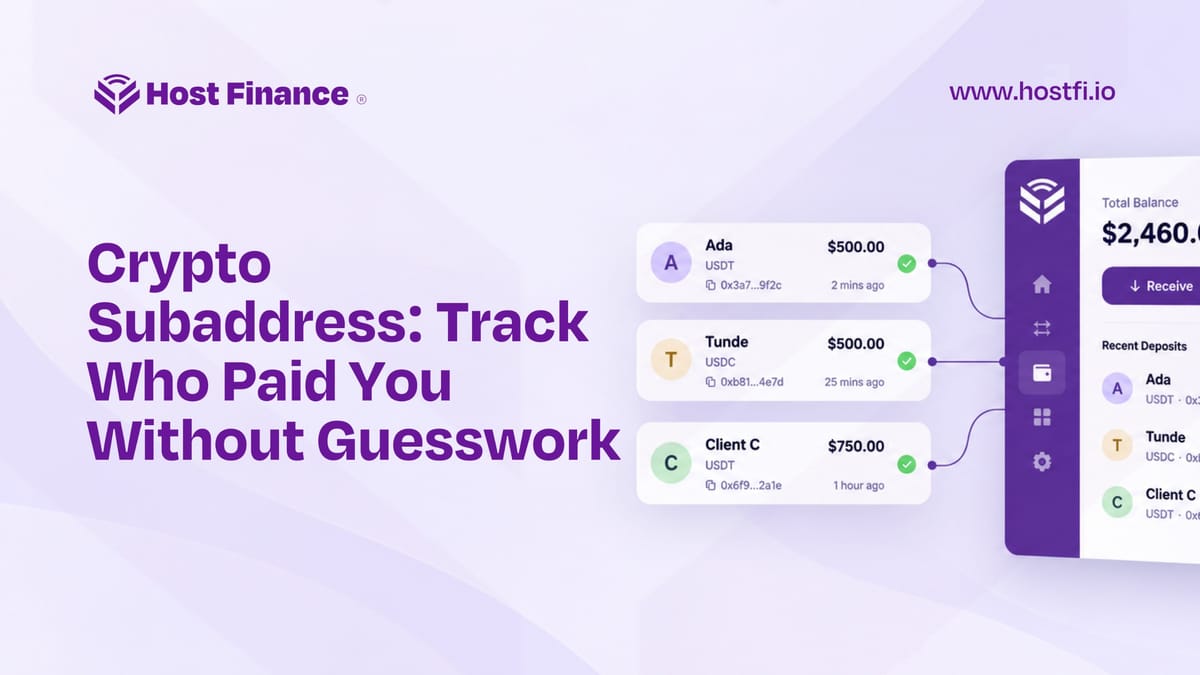
Three clients sent you USDT today. Your wallet shows three deposits, all at the same address, and none of them carries a name. Which client just paid? Which invoice is still open? A crypto subaddress settles those questions before they come up. Each client, project, or payment source gets its own deposit address, and every payment still lands in one wallet.
HostFi has now added subaddresses to the app. This guide explains what they are, why they matter, and how to create one in a few taps.
What Is a Crypto Subaddress?
A crypto subaddress is an extra deposit address linked to your main wallet. You can give a different one to each person paying you, or use one for each purpose. Every payment shows which address received it, and all the funds stay in the same wallet.
Why One Address for Every Payment Gets Messy
A bank transfer arrives with a name, a reference, and a date. A crypto transfer arrives as an amount and a long string of characters. If every client pays into the same crypto deposit address, you spend your time matching strangers to invoices.
Say Ada and Tunde each owe you $500 USD for logo work. Two deposits of 500 USDT show up an hour apart. You can guess who paid first, but you can't be sure. That is a shaky basis for running a business, and a shakier one for keeping records.
Clients also forget to send a message, pay late on a Friday evening, or split one payment into two. When each client has their own address, the address itself tells you who paid.
One Address vs. Subaddresses
| FEATURE | ONE ADDRESS FOR EVERYTHING | SUBADDRESSES |
|---|---|---|
| Identifying the sender | You compare amounts and times | The address points to the client or purpose |
| Matching payments to invoices | Manual and slow | Quick and clear |
| Bookkeeping | Mixed records | A cleaner trail per source |
| Where the funds sit | In your wallet | Still in your wallet |
How Subaddresses Help You Get Paid
Think of a subaddress as a labelled mailbox that empties into the same account. Here is how that plays out.
- Freelancers and agencies. Give each client their own subaddress. When money arrives, you know whose it is without sending a "did you pay?" message.
- Bookkeeping and tax time. Accountants keep a detailed record of every transaction, which they call a subledger. When your payments are already sorted by source, your own records come together almost by themselves, and filing your tax returns gets easier.
- Sellers and small businesses. Use one subaddress for your shop, another for a marketplace, and a third for family transfers. Your income streams stay apart.
Where the Idea Comes From
Subaddresses have been around for years. Monero's documentation says a subaddress is what you should use by default when receiving Monero. It advises creating one for each payment you expect, so you always know what you are being paid for. Other platforms have since built their own versions. The demand is easy to understand. As more people receive money in crypto, they want the record-keeping that banks give them for free.
How to Create a Subaddress on HostFi
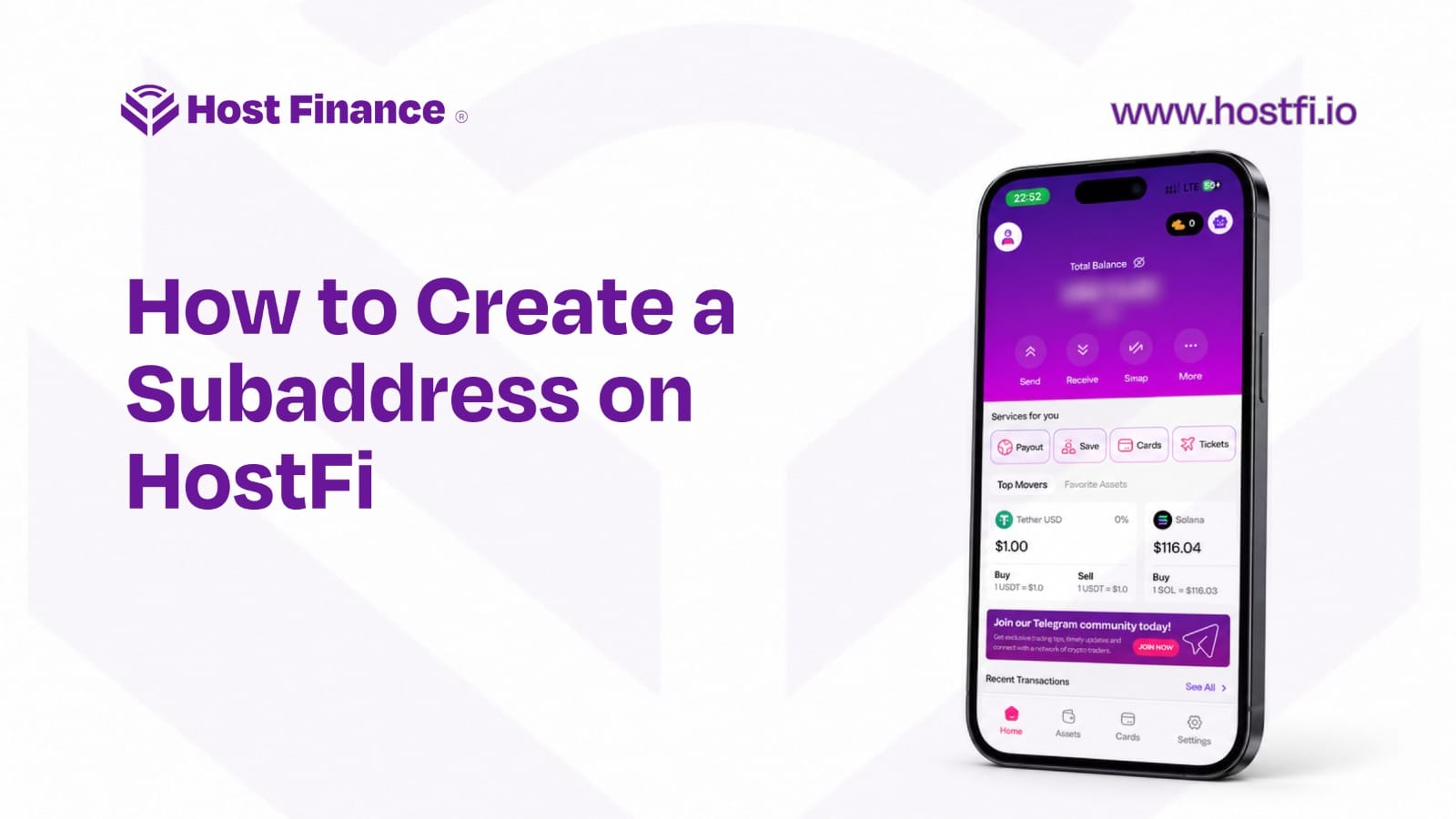
HostFi lets you create separate deposit addresses for supported assets inside your wallet. Your funds remain in your HostFi wallet, and each subaddress gives you a clearer way to keep track of incoming deposits.
- Open the HostFi app and tap Receive on the home screen.
- On the Receive Crypto screen, choose your asset from the first dropdown, such as USDT or USDC.
- Choose a network from the second dropdown.
- Your default wallet address appears under Saved Addresses, tagged Main. Tap Create Sub Address at the bottom of the screen.
- Type a label you will recognise, such as the client's name or the project, and tap Create Address to confirm.
- Copy the new address and send it to the person paying you.
Deposits on HostFi are free. Once a payment lands, you can swap it in the app with zero fees or withdraw it to your bank in Naira.
Five Habits that Make Subaddresses Work
- Label everything: A subaddress called "Client A" is easy to remember. An unnamed one is just another string of characters.
- Match the network: Ask your client to send on the same network you selected. Funds sent on the wrong network can be lost.
- Send a small test first: if the client is new or the amount is large.
- Keep your records: Note the date, client, invoice number, amount, and transaction hash (TXID) for each payment.
- Use one subaddress per client or purpose: Putting two clients on one subaddress defeats the point.
Bring Order to Your Income!
Getting paid in crypto should feel as clear as getting paid by bank transfer. A subaddress gives each payment a home with a name on it. If you are a freelancer, a seller, or anyone paid by international clients, it is one of the simplest ways to bring order to your income.
Open HostFi, tap Receive, create your first subaddress, and send it with your next invoice!
Frequently Asked Questions
How do I know who sent crypto to my wallet?
On its own, a blockchain transaction shows an address, not a name. With subaddresses, you create a different address for each client. When money arrives, the address tells you who it came from.
Can I have more than one wallet address?
Yes, on platforms that support it. Instead of opening several wallets, you create several deposit addresses within one wallet. On HostFi, these are subaddresses.
Is it safe to share my crypto wallet address?
A deposit address lets people send you money and gives them no way to take anything out. Addresses on public blockchains can be looked up on a block explorer, though, so share each subaddress only with the person it is meant for.
How do I get paid in USDT as a freelancer in Nigeria?
In HostFi, tap Receive, choose USDT, pick a network, and create a subaddress for your client. Share it and ask them to send on the same network. Once the payment lands, you can hold it as a dollar-backed asset or withdraw it as Naira to your bank.
How do I reconcile crypto payments for bookkeeping?
Record the date, amount, client, invoice number, and TXID for every payment. Because each subaddress points to a source, matching payments to invoices takes minutes.