How to Ask a New Client to Pay You in Crypto (Without Losing the Gig)
The best time to mention your payment method is before the client has a chance to assume one. Waiting until after the work is delivered puts you in a weak position, because now you are asking them to change a plan they already had in their head.


There is a particular kind of dread that comes right before you type the words "actually, could you pay me in USDT instead?" to a client you have just met. Your fingers hover over the keyboard. You picture the client reading it, frowning, going quiet, then quietly hiring someone else. So you delete the message and accept whatever payment method they offer, even when you already know it will cost you money you cannot afford to lose.
This fear is common among Nigerian freelancers, and it is not irrational. For nearly two decades, PayPal restricted Nigerian accounts to sending money only, locking freelancers out of one of the world's most recognised payment platforms. In January 2026 though, PayPal announced a partnership with the Nigerian fintech Paga meant to finally allow local users to receive and withdraw funds, but the rollout has been uneven, with many users still reporting account holds and verification problems months later. Meanwhile, platforms that do work often take a bite through fees and exchange rate margins before the money ever reaches a Nigerian bank account. None of this is the freelancer's fault, yet it is the freelancer who absorbs the cost.
Crypto, and stablecoins in particular, has become the workaround that millions of people have quietly turned into a standard. Nigeria ranks sixth globally in the 2025 Chainalysis Global Crypto Adoption Index, and led Sub-Saharan Africa with over $92.1 billion received on-chain. This is not a fringe habit picked up by a few tech-savvy freelancers. It is a documented, continent-leading pattern of ordinary people choosing digital dollars because the traditional rails were not built with them in mind. Knowing that switches up the conversation entirely. Rather than seeing it as you asking a client for a favour, you begin to see it as you asking them to use a payment method that millions of freelancers worldwide already prefer.
Why The Ask Feels Harder Than It Is
Freelancers often treat a payment method as though it were a personality trait of the client, something fixed and beyond negotiation. It rarely is. Most clients, especially those who hire internationally, simply default to whatever they used last time. They are not attached to PayPal or bank wires. They just have not been asked to consider anything else.
The freelancer community itself has spent years pushing back against unfair terms of engagement. The Freelancers Union has argued that independent workers should present themselves and their terms with the same confidence as any registered business, rather than accepting whatever a client proposes. A payment method request is part of that same posture.
Bring It Up Early, And Bring It Up First
The best time to mention your payment method is before the client has a chance to assume one. Waiting until after the work is delivered puts you in a weak position, because now you are asking them to change a plan they already had in their head. Raising it during onboarding, alongside your rate and your delivery timeline, makes it one detail among several rather than an awkward exception.
There is also value in naming the client's likely hesitation before they voice it themselves. If you expect a client to worry about volatility or unfamiliarity, say so first. It signals that you have thought this through and are not hiding anything, which tends to earn more trust than silence ever does.
Template for a new client, during onboarding:
"Before we get started, a quick note on payment: I invoice in USDT or USDC, which are digital dollars pegged 1:1 to the US dollar. This lets me avoid the delays and conversion losses that come with traditional international transfers, and it means you are not paying extra fees on your end either. I can walk you through it in under five minutes if it's your first time."
Template if the client raises hesitation:
"That's a fair question; a lot of clients ask this the first time. Stablecoins like USDT hold a steady 1:1 value with the US dollar, so there's no price risk on either side. Payment settles in minutes rather than days, and I'll send you the wallet address and a short screenshot guide so the whole thing takes less time than a bank transfer would."
Template for an existing client you want to migrate:
"I wanted to flag a change going forward: I'll be invoicing in USDT rather than [previous method]. It settles faster on my end and avoids the conversion fees that have been eating into past payments. Happy to send a quick guide so the first payment goes smoothly."
If a client still declines, ask them plainly what is holding them back rather than dropping the subject entirely. Often the objection is unfamiliarity rather than genuine refusal, and a short explanation resolves it.
Receiving and Cashing Out On HostFi
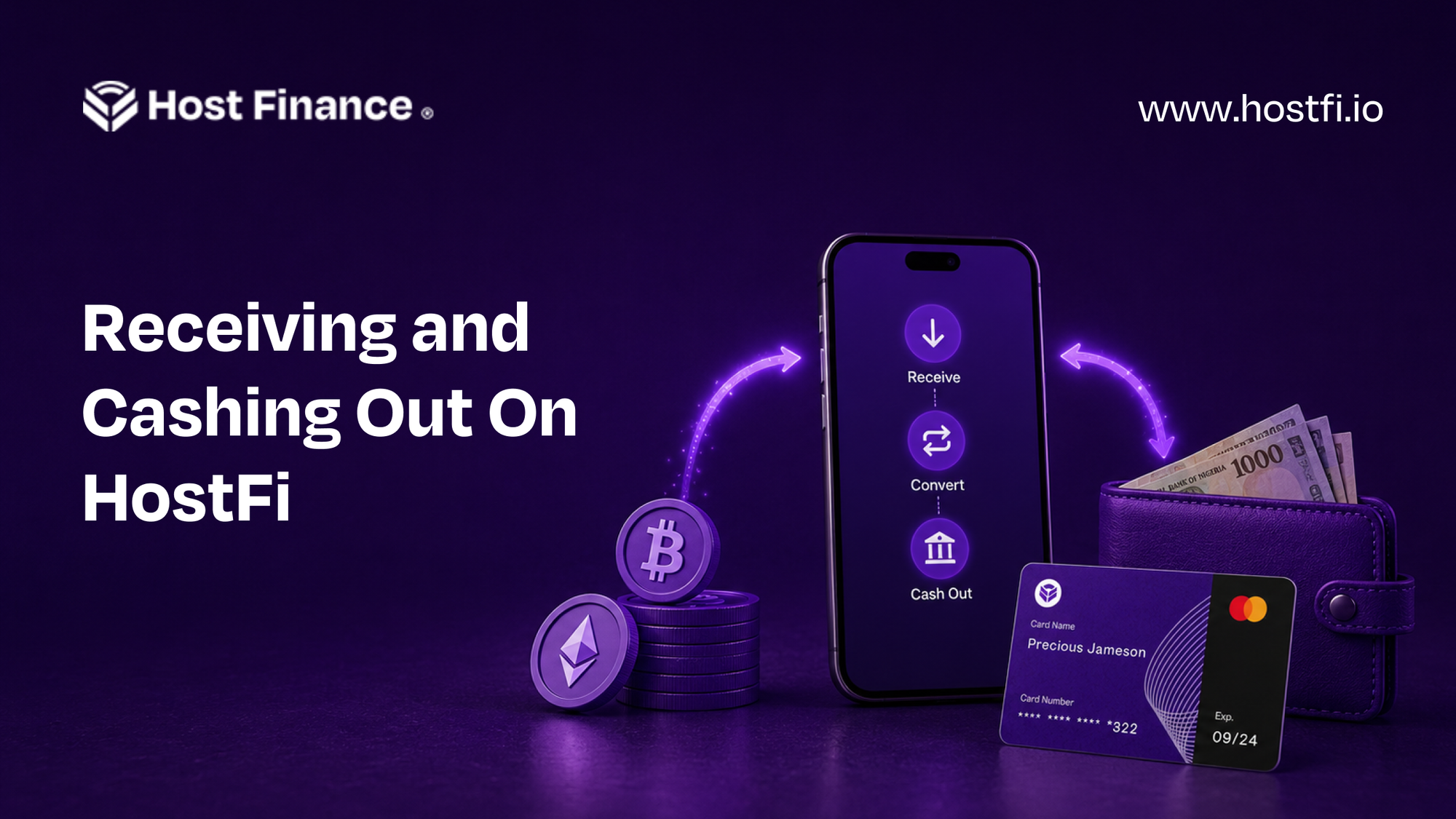
Once a client agrees, the mechanics are simple. On HostFi, you tap "Receive" from the home screen, choose the crypto and network the client is sending on (BEP20 for USDT sent from a lot of exchanges, or Solana for SOL, for example), then copy or scan the wallet address. Getting the network right matters. Sending on the wrong network can mean lost funds, so it is worth double-checking with the client before the first payment goes out.
Once the funds land, you have two options. If you want to hold value in dollars, you can simply leave it as USDT or USDC. If you need naira in hand, tap "Swap" from the home screen, select USDT as what you are paying with and NGN as what you want to receive, then confirm the amount. HostFi charges no fee on this conversion. From there, go to "More" and select "Withdraw Fiat," enter your bank details, and the naira instantly moves to your local bank account.
Getting Paid Should Not Require Nerve
Asking a client to pay you in crypto is not an unusual demand disguised in technical language. It is a payment preference, stated plainly, the same way you would state your rate or your deadline. By integrating stablecoins into your freelance contract, you take complete control of your wealth. You no longer have to fear arbitrary account bans or terrible exchange rates. Honestly, you work too hard to lose that much of your income to banking middlemen.